 |
Published June 17, 2026 |
What is New York’s Move Over Law?
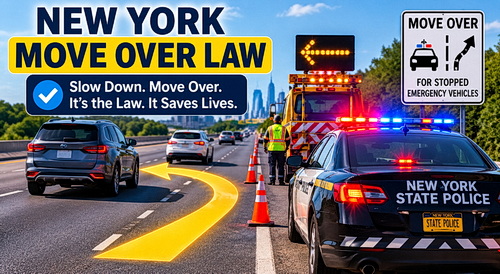
New York’s Move Over Law, found in Vehicle and Traffic Law §1144-a, requires drivers approaching a stopped vehicle on a highway shoulder to change one lane away when it is safe, or to slow to a reasonable speed when a lane change is not possible. Since March 27, 2024, it covers nearly any stopped vehicle.
The rule applies across the state, from the Long Island Expressway to local parkways. It exists because roadside workers and stranded motorists stand just feet from fast-moving traffic, and a single lane of space sharply reduces the risk of a deadly collision. Understanding the duty matters because a violation carries points, fines, and insurance consequences that outlast the ticket itself.
Which vehicles do you have to move over for in New York?
You must move over, or slow down when moving over is unsafe, for almost any vehicle stopped on a highway shoulder. The duty originally protected emergency responders, then grew to cover hazard and service vehicles, and now reaches stopped passenger cars.
Vehicles and personnel covered include:
- Police vehicles, ambulances, and fire trucks
- Tow trucks and highway maintenance vehicles
- Construction, utility, and sanitation vehicles
- Volunteer firefighters showing blue lights and volunteer ambulance personnel showing green lights
- Disabled or stopped vehicles on the shoulder, including ordinary passenger cars
When a safe lane change is possible, move one lane away. When traffic makes that impossible, reduce speed to a reasonable and prudent level as you pass.
When did New York expand the Move Over Law?
The Move Over Law expanded on March 27, 2024. Before that date, the duty centered on emergency and hazard vehicles displaying flashing lights. The newest provision, VTL §1144-a-d, now requires drivers to move over for any vehicle stopped on the shoulder of a highway, including a disabled passenger car with no lights at all.
This is the change most drivers miss. A motorist who safely passed a stopped car for years can now be cited for staying in the adjacent lane. Note that §1144-a is a different statute from VTL §1144, the separate failure to yield to an emergency vehicle offense, which carries heavier penalties.
Why do drivers get Move Over Law tickets on Long Island?
Most Move Over tickets come from routine moments that drivers do not register as violations. Passing a police traffic stop without changing lanes, riding beside a stopped tow truck, or rolling past a disabled car on the shoulder too closely can all draw a citation.
Common triggering situations include:
- Passing a traffic stop without moving over
- Staying in the lane next to emergency responders
- Failing to slow down when a lane change truly was not possible
- Passing a disabled vehicle on the shoulder too closely
Enforcement is heavy on the Long Island Expressway, the Southern State and Northern State Parkways, and Sunrise Highway, where officers actively watch for drivers who fail to clear the lane.
What are the penalties for a Move Over Law violation?
A Move Over Law conviction is a two-point offense. A first violation carries a fine of up to $150, a second violation within 18 months up to $300, and a third violation within 18 months up to $450, plus a mandatory state surcharge of roughly $88 to $93, depending on the court.
Beyond the court costs, the points sit on your driving record and frequently push insurance premiums higher for years. If a failure to move over contributes to injury or death, the consequences escalate well beyond a standard traffic fine. For many drivers, the long-term insurance increase ends up costing more than the ticket.
Can you fight a Move Over Law ticket in New York?
Yes. A citation is not automatically valid simply because an officer issued it. These cases turn on whether a lane change was actually safe and possible, and on what the officer could reasonably observe.
Potential defenses include:
- A lane change would have been unsafe given the surrounding traffic
- Heavy traffic made moving over impossible, and you slowed appropriately
- The stopped vehicle was not visible in time to react
- Road or weather conditions made compliance impossible
- The officer’s vantage point or observations were inaccurate
Dashcam footage, photographs, witness statements, and roadway diagrams can all support a defense. Every case depends on its specific facts, the roadway, and the available evidence.
Should you plead guilty to a Move Over Law ticket?
Pleading guilty is rarely the only option, and it locks in the points and the insurance fallout. Before you respond to the ticket, it is worth understanding the charge, the evidence against you, and whether the facts support a reduction or dismissal.
A traffic defense attorney can review the citation, identify whether a valid defense exists, and, in many cases, work to reduce the charge to a violation that keeps points off your record. If you received a Move Over Law ticket on Long Island, reviewing your options with Traffic Ticket Attorney NY before pleading guilty may help you avoid unnecessary points, fines, and premium increases.
Want to learn more about the traffic laws in New York State? Visit our traffic law and penalty guide!
Frequently Asked Questions
Is the Move Over Law the same as the law for emergency vehicles? No. VTL §1144-a is the Move Over Law for vehicles stopped on the shoulder. VTL §1144, failure to yield to a responding emergency vehicle, is a separate offense that carries three points and a higher fine.
Do I really have to move over for a regular broken-down car? Yes. Since March 27, 2024, VTL §1144-a-d requires drivers to move over for any vehicle stopped on a highway shoulder, including a disabled passenger car, whenever a lane change can be made safely.
How many points does a Move Over ticket add? A Move Over Law conviction adds two points to your New York driving record, which can also trigger higher insurance premiums.
What should I do right after getting the ticket? Avoid pleading guilty before you understand the charge. Note the road, traffic, and visibility conditions, preserve any dashcam footage, and have the citation reviewed so you know whether a defense or reduction is available.