 |
Published September 28, 2026 |
What happens if you get a ticket for tailgating in New York?
Following too closely in New York is a charge under Vehicle and Traffic Law Section 1129(a), which prohibits following another vehicle more closely than is reasonable and prudent given the speed, traffic, and road conditions. Traffic ticket attorney Patricia Scanlon represents drivers charged with moving violations in courts across New York State.
If you have ever driven on any of the “Big Three” – the Southern State, Northern State Parkways, or the Long Island Expressway, you have seen reckless driving and tailgating as if it were a common event. For the ones that are pulled over and ticketed by the police, they will be hit with some hefty fines!
What Will a Tailgating Ticket Cost You?
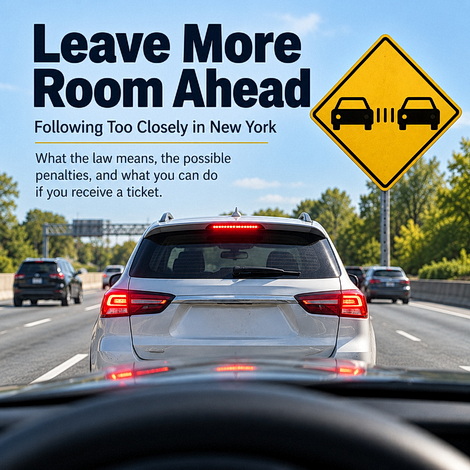
A conviction adds four points to your New York driving record and carries a fine of up to $150 for a first offense, plus mandatory state surcharges. Four points leave you just two points short of the six points in 24 months that trigger a Driver Responsibility Assessment of at least $300. Because the law sets no fixed distance, the ticket rests on an officer’s judgment of the conditions, and you can plead not guilty and contest it.
For how New York moving violations work in general, see our NY traffic tickets and moving violations guide.
What does following too closely actually mean under New York law?
Following too closely is defined in New York Vehicle and Traffic Law Section 1129(a). The full rule is one sentence:
“The driver of a motor vehicle shall not follow another vehicle more closely than is reasonable and prudent, having due regard for the speed of such vehicles and the traffic upon and the condition of the highway.”
In plain terms, the law does not set several feet, car lengths, or seconds. Instead, it asks whether your gap was sensible for three things: how fast the vehicles were moving, how much traffic was around you, and the condition of the road. A gap that is reasonable on a dry, empty road can be too close on a wet road in heavy traffic.
Two other parts of Section 1129 apply to specific drivers:
- Trucks and vehicles towing another vehicle. Outside a business or residence district, a truck or towing vehicle following another truck or towing vehicle must, whenever conditions permit, leave enough space for a passing vehicle to move in safely. It may still pass.
- Caravans and motorcades. Outside a business or residence district, vehicles traveling as a group must leave enough space between them for another vehicle to enter safely. This part does not apply to funeral processions.
A crash is not part of the definition. You can be charged for the distance you kept even if nothing happened.
How close is too close? The two-second rule
Because the law gives no fixed distance, the practical yardstick most New York drivers learn is the two-second rule from the New York State DMV Driver’s Manual:
- Pick a fixed object ahead, such as a sign, tree, or overpass.
- When the vehicle ahead passes it, count slowly: “one thousand one, one thousand two.”
- If you reach the object before you finish counting, you are following too closely.
- In bad weather and when following large trucks, the manual says to increase the count to at least three or four seconds.
Keep in mind that the two-second rule is DMV safety guidance, not wording in Section 1129. It is a good habit, but the legal question is still whether your distance was reasonable and prudent for the conditions at that moment.
The DMV explains why the rule matters: according to the Driver’s Manual, four of every 10 crashes involve rear-end collisions, normally because a person is following too closely. The manual also identifies the rear-end collision as the most common crash in a work zone and advises keeping at least two seconds of braking distance there.
How many points and how much is a following too closely ticket in NY?
A following too closely conviction adds 4 points to your New York driving record. Section 1129 does not set its own fine, so the general penalty for traffic infractions under Vehicle and Traffic Law Section 1800 applies. The fine goes up if you have other traffic convictions within 18 months. The full rules are in our article on How the Point System Works.
| Consequence | What New York law provides |
|---|---|
| DMV license points | Four points |
| First conviction | Fine of up to $150, up to 15 days in jail, or both |
| Second conviction (both violations within 18 months) | Fine of up to $300, up to 45 days in jail, or both |
| Third or later conviction (all within 18 months) | Fine of up to $450, up to 90 days in jail, or both |
| Mandatory surcharges and fee | $88 in addition to any fine ($93 in a town or village court) |
These amounts are the maximums set by statute. The court or DMV tribunal that hears your ticket decides the actual fine, which can be lower. The four points can also lead to a separate state fee and count toward a possible suspension, as explained below.
How a 4-point ticket adds up on your record
Points are added only after a conviction, and the DMV counts them by the date of the violation, not the date of the conviction. Two thresholds matter most for a 4-point ticket.
The 6-Point Driver Responsibility Assessment
If you receive 6 or more points for violations committed within 18 months, the DMV charges a Driver Responsibility Assessment. It is separate from the court fine and surcharges. At six points, it is $100 a year for three years ($300 total), plus $25 a year for each point above six.
Here is how quickly that happens with a tailgating conviction:
| Tickets within 18 months | Total points | Driver Responsibility Assessment |
| Following too closely alone | 4 | None |
| Following too closely plus a 2-point moving violation | 6 | $100 a year for 3 years ($300) |
| Following too closely plus speeding 11 to 20 mph over (4 points) | 8 | $150 a year for 3 years ($450) |
The 11-point suspension threshold
The DMV may suspend your license if you get 11 points in 24 months. A single following too closely conviction uses up 4 of those 11 points. Once 24 months pass from the violation date, the points stop counting toward that total, but they stay on your driving record as long as the conviction does, and the DMV notes that insurance companies can use your record to raise your premiums.
A DMV-approved Point and Insurance Reduction Program course does not remove the four points from your record, but it can offset up to 4 points when the DMV calculates a suspension.
Following too closely tickets and commercial drivers
For drivers who hold a commercial learner’s permit or commercial driver license (CDL), a following too closely conviction carries a second layer of risk. Federal rules at 49 CFR 383.51 list “following the vehicle ahead too closely” as a serious traffic violation.
- A second conviction for any combination of listed serious traffic violations, in separate incidents within 3 years while driving a commercial motor vehicle, means a 60-day disqualification from driving a commercial vehicle.
- A third or later conviction within three years means a 120-day disqualification.
- Convictions in your personal vehicle also count, but only if the conviction results in the revocation, cancellation, or suspension of your license or non-commercial driving privileges.
Truck drivers should also remember the separate spacing duty in Section 1129(b) described above.
Where your ticket will be heard
- In the five boroughs of New York City, non-criminal traffic tickets are handled by the DMV’s Traffic Violations Bureau (TVB), not a local court. The city layers its own rules on top of state law, which are covered in New York City traffic violations and penalties.
- Outside New York City, the ticket goes to the city, town, or village court where the violation happened. You can find the right one in our New York courts directory.
What are your options after a following too closely ticket?
You have two basic choices: plead guilty and pay, or plead not guilty and have the charge decided at a hearing or trial. At the TVB, paying the ticket is a guilty plea, and once you plead guilty, you cannot change your plea.
If you plead not guilty at the TVB, the DMV states that you are considered innocent unless proven guilty, and you cannot be found guilty without clear and convincing evidence. The officer testifies about why the ticket was written, and you or your attorney may question the officer, testify, bring witnesses, and present evidence.
Because Section 1129(a) turns on what was reasonable and prudent for the speed, the traffic, and the road conditions, those facts are the heart of the case. Write down what you remember about them as soon as you can.
Whatever you decide, do not ignore the ticket. At the TVB, failing to answer leads to a license suspension, and continuing to ignore it leads to a default conviction, which counts the same as a guilty finding.
Frequently asked questions
Is following too closely a crime in New York?
No. Under Section 1800, breaking a Vehicle and Traffic Law rule is a traffic infraction unless the law specifically makes it a misdemeanor or felony, and Section 1129 does not. It is still a moving violation that carries points, fines, and possible jail time under the statute.
Will a tailgating ticket from another state put points on my New York license?
Generally no. The DMV does not add points to your New York record for convictions in other states, although convictions in Canadian provinces are recorded. You still must answer the ticket: New York will suspend your license if you fail to answer a moving violation ticket from any state except Alaska, California, Michigan, Montana, Oregon, or Wisconsin.
Can I be ticketed for following too closely in stop-and-go traffic?
Yes. The law applies at any speed and asks whether your distance was reasonable for the traffic and road conditions at that time, so heavy traffic does not by itself excuse a short gap.
Patricia Scanlon has been a licensed New York attorney for 33 years and represents drivers in traffic courts across New York State, including Long Island, New York City, Westchester, and upstate courts. In most cases, she can appear on your behalf, so you do not have to take time off work. To get started, text a photo of your driver’s license and your ticket to 516-439-9442, or call the same number.
Attorney Advertising. Prior results do not guarantee a similar outcome.